Linear Analysis
Normed Spaces
Definitions and examples
Definition
Let $X$ be a (real or complex) vector space. A norm on $X$ is a function $\lVert \cdot \rVert : X \to \mathbb{R}$ such that
- $\lVert x \rVert \geq 0 \quad \forall x \in X$, with equality iff $x = 0$ (positivity);
- $\lVert \lambda x \rVert = |\lambda|\ \lVert x \rVert \quad \forall x \in X$ and scalars $\lambda$ (homogeneity);
- $\lVert x + y \rVert \leq \lVert x \rVert + \lVert y \rVert \quad \forall x, y \in X$ (triangle inequality).
$\lVert x \rVert$ is called the norm or length of $x$.
A normed space is a pair $(X, \lVert \cdot \rVert)$ where $X$ is a vector space and $\lVert \cdot \rVert$ is a norm on $X$.
Examples
-
$\ell_2^n \coloneqq (\mathbb{R}^n, \lVert \cdot \rVert_2)$ (or $(\mathbb{C}^n, \lVert \cdot \rVert_2)$), where $$\lVert x \rVert_2 \coloneqq \left(\sum_{i=1}^n |x_i|^2 \right)^{1/2}$$ for $x = (x_1, \dots, x_n) \in \mathbb{R}^n$ (the $\ell_2$-norm or Euclidean norm).
Check the three properties: (i), (ii) are easy; (iii) follows from Cauchy–Schwarz.
-
$\ell_1^n \coloneqq (\mathbb{R}^n, \lVert \cdot \rVert_1)$, where $\lVert x \rVert_1 \coloneqq \sum_{i=1}^n |x_i|$ (the $\ell_1$-norm).
(i), (ii) easy; (iii): $|x_i + y_i| \leq |x_i| + |y_i|$, sum over $i$.
-
$\ell_{\infty}^n \coloneqq (\mathbb{R}^n, \lVert \cdot \rVert_{\infty})$, where $\lVert x \rVert_{\infty} \coloneqq \max_{1 \leq i \leq n} |x_i|$ (the $\ell_{\infty}$-norm or sup-norm).
(i), (ii), (iii) easy.
Given a normed space $X$, its norm $\lVert \cdot \rVert$ induces a metric $d$ on $X$: $$d(x,y) = \lVert x-y \rVert$$
Exercise: check this is a metric.
$d(x,y) \geq 0, =0 \iff x-y = 0 \iff x=y \quad \checkmark$
$d(y,x) = \lVert y-x \rVert = \lVert (-1)(x-y) \rVert = \lVert x-y \rVert = d(x,y) \quad \checkmark$
$d(x,z) = \lVert x-z \rVert = \lVert (x-y)-(y-z) \rVert \leq \lVert x-y \rVert + \lVert y-z \rVert = d(x,y) + d(y,z) \quad\checkmark$
Then $d$ induces a topology on $X$ called the norm topology of $X$. We can now talk about continuity e.g. the algebraic operations are (sequentially) continuous:
- If $x_n \to x, y_n \to y$ in $X$ then $x_n + y_n \to x+y$
- If $x_n \to x, \lambda_n \to \lambda$ in scalar field, then $\lambda_n x_n \to \lambda x$.
Also the norm $\lVert \cdot \rVert : X \to \mathbb{R}$ is continuous since $\Big| \lVert x \rVert - \lVert y \rVert \Big| \leq \lVert x-y \rVert$ by reverse triangle inequality, so $\lVert \cdot \rVert$ is even 1-Lipschitz.
Definition
A Banach space is a complete normed space, i.e. a normed space that is complete in its norm topology.
For example, $\ell_2^n, \ell_1^n, \ell_\infty^n$ are complete, because we can look coordinate-wise: $x^{(k)} \to x$ in one of these spaces $\iff x_i^{(k)} \to x_i \;\forall\; 1 \leq i \leq n$, and $(x^{(k)})_{k=1}^\infty$ is Cauchy iff $(x_i^{(k)})_{k=1}^\infty$ is Cauchy for each $i = 1, \dots, n$.
In a normed space $X$, a useful object is the unit ball $B_X \coloneqq \{ x \in X \mid \lVert x \rVert \leq 1\}$.

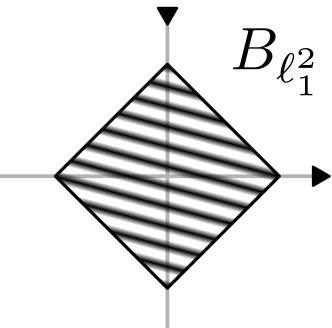
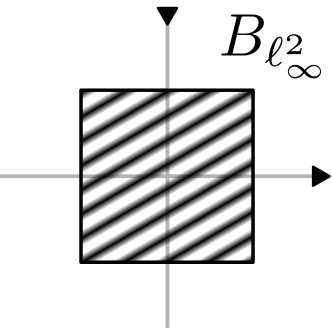
Remarks
- $B_X$ determines the norm: $\lVert x \rVert = \inf\{ t \geq 0 \mid x \in t B_X\}$.
- $B_X$ is symmetric, convex, and closed: $x \in B_X \iff -x \in B_X$, and if $x,y \in B_X, t \in [0,1]$, then $(1-t)x + ty \in B_X$, since $\lVert (1-t)x + ty\rVert \leq (1-t)\lVert x \rVert + t \lVert y \rVert \leq 1$.
- If $B \subset \mathbb{R}^n$ is a closed, convex, symmetric, bounded neighbourhood of 0, then $B$ is the unit ball of $(\mathbb{R}^n, \lVert \cdot \rVert)$ for some norm $\lVert \cdot \rVert$.
More Examples
-
$\ell_p^n \coloneqq (\mathbb{R}^n, \lVert \cdot \rVert_p)$, where $1 \leq p < \infty$, $\lVert x \rVert_p \coloneqq \left(\sum_{i=1}^n |x_i|^p\right)^{1/p}$ (the $\ell_p$-norm).
(i), (ii) easy, (iii) not obvious (done later; see ?).
-
Let $S$ denote the set of all scalar sequences. This is a vector space in the coordinate-wise operations: $(x_n) + (y_n) = (x_n + y_n), \lambda \cdot (x_n) = (\lambda x_n)$.
$\ell_1 \coloneqq \Big\{(x_n) \in S \;\Big|\; \sum_{n=1}^{\infty} |x_n| < \infty\Big\},\; \lVert (x_n) \rVert_1 \coloneqq \sum_{n=1}^\infty |x_n|$ (the $\ell_1$-norm).
(i), (ii) easy. (iii): given $x = (x_n), y = (y_n) \in \ell_1$,
- $|x_n + y_n| \leq |x_n| + |y_n| \;\forall\; n \in \mathbb{N}$.
- Sum over $n \in \mathbb{N}$ to get that $x + y \in \mathbb{\ell_1}$ and $\lVert x + y \rVert_1 \leq \lVert x \rVert_1 + \lVert y \rVert_1$.
So $\ell_1$ is a subspace of $S$ and $\lVert \cdot \rVert_1$ is a norm on $\ell_1$.
-
$\ell_2 \coloneqq \Big\{(x_n) \in S \;\Big|\; \sum_{n=1}^{\infty} |x_n|^2 < \infty\Big\},\; \lVert (x_n) \rVert_2 \coloneqq \left(\sum_{n=1}^\infty |x_n|^2 \right)^{1/2}$ (the $\ell_2$-norm).
(i), (ii) easy. (iii): given $x = (x_n), y = (y_n) \in \ell_2$,
- $\left(\sum_{k=1}^n |x_k+y_k|^2\right)^{1/2} \leq \left(\sum_{k=1}^n |x_k|^2\right)^{1/2} + \left(\sum_{k=1}^n |y_k|^2\right)^{1/2}$ by triangle inequality in $\ell_2^n$.
- Let $n \to \infty$: get that $x + y \in \mathbb{\ell_2}$ and $\lVert x + y \rVert_2 \leq \lVert x \rVert_2 + \lVert y \rVert_2$.
So $\ell_2$ is a subspace of $S$ and $\lVert \cdot \rVert_2$ is a norm on $\ell_2$.
More generally, for $1 \leq p < \infty$, $\ell_p \coloneqq \Big\{(x_n) \in S \mid \sum_{n=1}^\infty |x_n|^p < \infty \Big\}$ is a subspace of $S$ and $\lVert (x_n) \rVert_p \coloneqq \left(\sum_{n=1}^\infty |x_n|^p \right)^{1/p}$ is a norm (the $\ell_p$-norm) on $\ell_p$ (once we have the triangle inequality in $\ell_p^n$, which we will do soon; see ?).
-
$\ell_\infty \coloneqq \Big\{(x_n) \in S \;\Big|\; \exists M \geq 0 \quad \forall n \quad |x_n| \leq M \Big\},\; \lVert (x_n) \rVert_\infty \coloneqq \sup_{n \in \mathbb{N}} |x_n|$ (the $\ell_\infty$-norm or sup-norm).
(i), (ii) easy. (iii): given $x = (x_n), y = (y_n) \in \ell_\infty$,
- $|x_n + y_n| \leq |x_n| + |y_n| \leq \lVert x \rVert_\infty + \lVert y \rVert_\infty \;\forall\; n \in \mathbb{N}$.
- So $x+y \in \ell_\infty$ and $\lVert x+y \rVert_\infty \leq \lVert x \rVert_\infty + \lVert y \rVert_\infty$.
-
$c_0 \coloneqq \Big\{(x_n) \in S \;\Big|\; x_n \to 0 \text{ as } n \to \infty \Big\}$
$c \coloneqq \Big\{(x_n) \in S \;\Big|\; \lim_{n \to \infty} x_n \text{ exists} \Big\}$
These are subspaces of $\ell_\infty$ and hence normed spaces in $\lVert \cdot \rVert_\infty$.
Examples 5-8 are called sequence spaces. They are "infinite-dimensional analogues" of examples 1-4.
Inequalities of Minkowski and Hölder
tl;dr
We aim at proving these two ubiquitous inequalities. Minkowski is just the triangle inequality for $\ell_p^n$, and Hölder is a generalisation of Cauchy-Schwarz.
Recall that a function $f : (0, \infty) \to \mathbb{R}$ is convex if $\forall\; x,y \in (0,\infty)$ and $\forall\; t \in [0,1]$, $$f((1-t)x+ty) \leq (1-t)f(x) + tf(y)$$ and concave if $\geq$.
Lemma
Let $1 \leq p < \infty$. Then $x \mapsto x^p: (0,\infty) \to \mathbb{R}$ is convex.
Proof
We need to show $((1-t)x + ty)^p \leq (1-t)x^p + ty^p \;\forall\; x,y \in (0,\infty) \;\forall\; t \in [0,1]$.
Fix $y > 0, t \in [0,1]$. Define $g(x)$ to be the difference:
$$g(x) = \left((1-t)x + ty\right)^p - \left((1-t)x^p + ty^p\right),\quad x > 0.$$
Want $g(x) \leq 0 \;\forall\; x > 0$, then done.
$$g'(x) = p(1-t)\left((1-t)x + ty\right)^{p-1} - p(1-t)x^{p-1}.$$
If $0 < x < y$ then $g'(x) \geq 0$. If $y < x$ then $g'(x) \leq 0$. In either case, by MVT have $g(x) \leq g(y) = 0 \;\forall\; x \in (0, \infty)$.
Theorem (Minkowski)
Let $1 \leq p < \infty$, $n \in \mathbb{N}$. For $x,y \in \mathbb{R}^n$ (or $\mathbb{C}^n$), $$\lVert x + y \rVert_p \leq \lVert x \rVert_p + \lVert y \rVert_p$$
(This shows that $\ell_p^n = (\mathbb{R}^n, \lVert\cdot\rVert_p)$ and $(\ell_p, \lVert\cdot\rVert_p)$ are normed spaces.)
Proof of Minkowski
Let $B = \{x \in \mathbb{R}^n \mid \lVert x \rVert_p \leq 1\}$. We will show $B$ is a convex set later (necessary). Then we complete the proof as follows:
Let $x,y \in \mathbb{R}^n$. Need $\lVert x+y \rVert_p \leq \lVert x \rVert_p + \lVert y \rVert_p$. WLOG $x,y,x+y$ nonzero.
$$\begin{aligned} \frac{x+y}{\lVert x \rVert_p + \lVert y \rVert_p} &= \frac{\lVert x \rVert_p}{\lVert x \rVert_p + \lVert y \rVert_p} \cdot \frac{x}{\lVert x \rVert_p} + \frac{\lVert y \rVert_p}{\lVert x \rVert_p + \lVert y \rVert_p} \cdot \frac{y}{\lVert y \rVert_p}\\ & \in B \text{ since convex combination of elts of } B. \end{aligned}$$
Hence $\lVert \frac{x+y}{\lVert x \rVert_p + \lVert y \rVert_p} \rVert_p \leq 1$, so $\lVert x+y \rVert_p \leq \lVert x \rVert_p + \lVert y \rVert_p \; \checkmark$
-
To show $B$ is convex: let $x,y \in B, t \in [0,1]$. Need $(1-t)x + ty \in B$.
For $1 \leq k \leq n$, $$|(1-t)x_k + ty_k|^p \leq \left((1-t)|x_k| + t |y_k| \right)^p \leq (1-t) |x_k|^p + t|y_k|^p$$ where the second inequality is by ? if $x_k \neq 0, y_k \neq 0$, otherwise trivial.
Sum over $k$:
$$\lVert (1-t)x + ty \rVert_p^p \leq (1-t) \underbrace{\lVert x \rVert_p^p}_{\leq 1} + t \underbrace{\lVert y \rVert_p^p}_{\leq 1} \leq 1 \; \checkmark$$
So $(1-t)x + ty \in B$.
Exercise
Show that $\ell_p, 1 \leq p \leq \infty$, is complete. (Slick proof later; see ?).
Now onto Hölder.
Let $1 < p < \infty$. The conjugate index of $p$ is the unique $q$, $1 < q < \infty$, such that $\frac{1}{p} + \frac{1}{q} = 1$. For example if $p=2$ then $q=2$.
Lemma (Young's inequality)
Let $ 1 < p,q < \infty$ with $\frac{1}{p} + \frac{1}{q} = 1$. Then $\forall a,b \geq 0,$ $$ab \leq \frac{a^p}{p} + \frac{b^q}{q}$$
Proof
WLOG $a>0, b>0$. Take log of both sides, and use concavity of log.
Theorem (Hölder)
Let $ 1 < p,q < \infty$ with $\frac{1}{p} + \frac{1}{q} = 1$. Then for $x \in \ell_p, y \in \ell_q$, we have $x \cdot y = (x_n y_n) \in \ell_1$ and $$\lVert x \cdot y \rVert_1 \leq \lVert x \rVert_p \cdot \lVert y \rVert_q$$
Remarks
- $p=1, q=\infty$ also works:
- Let $x = (x_n) \in \ell_1, y = (y_n) \in \ell_\infty$. Then $\forall n$, $|x_n y_n| = |x_n| \cdot |y_n| \leq |x_n| \cdot \lVert y \rVert_\infty$.
- So by comparison test, $x \cdot y = (x_n y_n) \in \ell_1$ and $\lVert x \cdot y \rVert_1 \leq \lVert x \rVert_1 \cdot \lVert y \rVert_\infty$.
- $p=q=2$ is Cauchy-Schwarz.
Proof of Hölder
WLOG $x \neq 0, y \neq 0$. By homogeneity, WLOG $\lVert x \rVert_p = \lVert y \rVert_q = 1$.
By Young's inequality, $|x_n y_n| \leq \frac{|x_n|^p}{p} + \frac{|y_n|^q}{q} \;\forall n$. Sum over $n$: $$\begin{aligned} \sum_{n=1}^\infty |x_n y_n| &\leq \frac{\lVert x \rVert_p^p}{p} + \frac{\lVert y \rVert_q^q}{q}\\ &= \frac{1}{p} + \frac{1}{q} = 1 = \lVert x \rVert_p \cdot \lVert y \rVert_q. \end{aligned}$$
Exercise
Deduce Minkowski from Hölder.
More examples of normed spaces
-
$C[0,1] \coloneqq \big\{f : [0,1] \to \mathbb{R} \mid f \text{ is continuous}\big\}$, $\lVert f \rVert_\infty \coloneqq \sup_{x \in [0,1]} |f(x)|$ (sup-norm or uniform norm)
This is a Banach space (recall uniform limit of cts fns is cts).
-
More generally, given a compact Hausdorff space $K$, $$C(K) \coloneqq \big\{f:K\to\mathbb{R} \mid f \text{ cts}\big\}$$ is a Banach space in the sup-norm $\lVert f \rVert_\infty \coloneqq \sup_{x \in K} |f(x)|$. (We will look at compact Hausdorff spaces in depth later.)
-
$C[0,1]$ with the $L^1$-norm $\lVert f \rVert_1 \coloneqq \int_0^1 |f(t)| dt, f \in C[0,1]$
This is a normed space, but is incomplete:
![C[0,1] is incomplete](C01_incomplete.svg)
More generally, $C[0,1]$ is incomplete in the $L^p$-norm, $1 \leq p < \infty$, $\lVert f \rVert_p \coloneqq \left(\int_0^1 |f(t)|^p dt\right)^{1/p}$ (same counterexample).
$\big[$ In II Prob & Measure, the completion of $\left(C[0,1], \lVert \cdot \rVert_p\right)$ is $L^p[0,1]$ $\big]$
-
$C^1[0,1] \coloneqq \big\{ f \in C[0,1] \mid f \text{ ctsly diffble} \big\} \subseteq C[0,1]$ is a subspace. So it's a normed space in $\lVert \cdot \rVert_\infty$, but is incomplete, i.e. not closed in $C[0,1]$.
It is complete in the norm $\lVert f \rVert = \lVert f \rVert_\infty + \lVert f' \rVert_\infty$ (see example sheet 1).
-
$\Delta \coloneqq \big\{ z \in \mathbb{C} \mid |z| \leq 1 \big\}$
$A(\Delta) \coloneqq \big\{ f \in C(\Delta) \mid f \text{ analytic on int}(\Delta) \big\}$ is a subspace of $C(\Delta)$, and a closed space [uniform limit of holomorphic fns is holomorphic], hence a Banach space in $\lVert \cdot \rVert_\infty$.
More on the normed topology
Let $X$ be a normed space, $A \subseteq X$ subset. Recall the closure of $A$ is $\overline{A} = \big\{ x \in X \mid \exists (a_n) \in A \text{ such that } a_n \to x \text{ as } n \to \infty \big\}$.
Say $A$ is dense in $X$ if $\overline{A} = X$. (Equivalently, $A$ intersects every nonempty open set.)
Say $X$ is separable if it has a countable dense subset. (For a metric space, this is equivalent to being second countable.)
If $Y \subseteq X$ is a (vector) subspace, then so is $\overline{Y}$: if $x,y \in \overline{Y}$, then
- $\exists (x_n), (y_n) \in Y$ s.t. $x_n \to x, y_n \to y$.
- So $\lambda x_n + \mu y_n \to \lambda x + \mu y \in \overline{Y}$.
Similarly, if $A \subseteq X$ is convex, then so is $\overline{A}$.
Definition
For a subset $A$ of a normed space $X$, the closed linear span of $A$, denoted $\overline{\text{span}} A$, is $\overline{\text{span} A}$, which is a closed subspace of $X$.
Note: if $A$ is countable then $\overline{\text{span}} A$ is separable: take the set of all rational linear combinations of elements of $A$; this is countable and dense in $\overline{\text{span}A}$.
Examples
-
$\overline{\mathbb{Q}} = \mathbb{R}$, so $\mathbb{R}$ is separable.
-
$\ell_p, 1 \leq p < \infty$, is separable: let $$\begin{aligned} e_n &\coloneqq (0, \dots, 0, \underbrace{1}_{n^{th}\text{ space}}, 0, \dots), n \in \mathbb{R}\\ c_{00} &\coloneqq \text{span}\{e_n \mid n \in \mathbb{N}\}\\ &= \{(x_n) \in S \mid x_n \text{ is eventually constantly } 0\} \end{aligned}$$
Recap: we've defined $c \supseteq c_0 \supseteq c_{00}$
$c = \big\{\text{limit exists}\big\}$, $c_0 = \big\{\text{limit is 0}\big\}$, $c_{00} = \big\{\text{eventually constantly 0}\big\}$
Then $\ell_p = \overline{\text{span}}\{e_n \mid n \in \mathbb{N}\}$: for $x = (x_n) \in \ell_p$, we can approximate by "matching elements left-to-right": $$\lVert x - \sum_{i=1}^n x_i e_i \rVert_p = \left(\sum_{i > n} |x_i|^p\right)^{1/p} \to 0 \text{ as } n \to \infty.$$
-
Similarly, in $\ell_\infty$, $\overline{c_{00}} = \overline{\text{span}}\{e_n \mid n \in \mathbb{N}\} = c_0$ (see example sheet 1).
-
$c_0$ is separable, by the above note. ($c_0 = \overline{c_{00}}$, $c_{00}$ countable)
-
$\ell_\infty$ is not separable. (it contains unctble collection of disjoint open sets; see example sheet 1)
Bounded linear maps
Theorem
Let $X,Y$ be normed spaces and $T: X \to Y$ a linear map. The following are equivalent:
- $T$ is cts at 0
- $T$ is cts
- $T$ is Lipschitz
- T is bounded i.e. $\exists C \geq 0$ s.t. $\forall x \in X, \lVert Tx \rVert \leq C \lVert x \rVert$
Proof
(iv) $\implies$ (iii): $\lVert Tx - Ty \rVert = \lVert T(x-y) \rVert \leq C\lVert x-y \rVert$
(iii) $\implies$ (ii): immediate
(ii) $\implies$ (i): obvious
(i) $\implies$ (iv):
-
$\exists \delta > 0$ s.t. $\forall x \in X,$ if $\lVert x \rVert \leq \delta$ then $\lVert Tx-T0 \rVert = \lVert Tx \rVert\leq 1$.
-
For $x \neq 0$, $\frac{\delta x}{\lVert x \rVert} = \delta$, so $\Big\lVert T\left(\frac{\delta x}{\lVert x \rVert}\right) \Big\rVert \leq 1$, which implies $\lVert Tx \rVert \leq \frac{1}{\delta} \lVert x \rVert$.
For normed spaces $X$ and $Y$, let $$\mathcal{B}(X,Y) \coloneqq \big\{T: X \to Y \mid T \text{ linear and bounded}\big\}$$ and for $T \in \mathcal{B}(X,Y)$, we define its operator norm $\lVert T \rVert := \sup \big\{ \lVert Tx \rVert \mid x \in B_X \big\}$.
$\lVert T \rVert$ is the least $C$ such that (iv) above holds.
This is very useful; it tells us how to actually compute operator norms. Easy to prove:
- We have some $C \geq 0$ such that $\forall x, \lVert Tx \rVert \leq C \lVert x \rVert$. So if $\lVert x \rVert \leq 1$, then $\lVert Tx \rVert \leq C$. So $\lVert T \rVert \leq C$ (since sup = least upper bound).
- Conversely, $\forall x \in B_X, \lVert Tx \rVert \leq \lVert T \rVert$, so by homogeneity $\lVert Tx \rVert \leq \lVert T \rVert \cdot \lVert x \rVert$. So $\lVert T \rVert$ is such a $C$.
The operator norm is a norm on $\mathcal{B}(X,Y)$: given $S,T \in \mathcal{B}(X,Y), \forall x \in X$ we have $$\lVert (S+T)x \rVert = \lVert Sx + Tx \rVert \leq (\lVert S \rVert + \lVert T \rVert)\lVert x \rVert$$ $$\implies S+T \in \mathcal{B}(X,Y) \text{ and } \lVert S+T \rVert \leq \lVert S \rVert + \lVert T \rVert.$$
Notation: $\mathcal{B}(X)$ for $\mathcal{B}(X,X)$.
Proposition
Let $X,Y,Z$ be normed spaces, $S \in \mathcal{B}(X,Y), T \in \mathcal{B}(Y,Z)$, then $TS \in \mathcal{B}(X,Z)$ and $\lVert TS \rVert \leq \lVert T \rVert \cdot \lVert S \rVert$.
Proof
$\forall x \in X, \lVert TSx \rVert \leq \lVert T \rVert \cdot \lVert Sx \rVert \leq \lVert T \rVert \cdot \lVert S \rVert \cdot \lVert x \rVert$
Examples
-
$T: \ell_2^n \to \ell_2^n,\; T(x_1, \dots, x_n) = (x_1, \dots, x_r, 0, \dots, 0), 1 \leq r \leq n$.
$\lVert Tx \rVert_2 = \left(\sum_{i=1}^r |x_i|^2\right)^{1/2} \leq \lVert x \rVert_2$. So $\lVert T \rVert \leq 1$.
But $Te_1 = e_1$, so $\lVert T \rVert = 1$.
More generally, if $T$ has matrix $A = (a_{ij})$ w.r.t. standard basis, then $\lVert T \rVert \leq \left(\sum_{i,j=1}^n |a_{ij}|^2\right)^{1/2}$ by Cauchy-Schwarz.
-
Let $1 \leq p \leq \infty,\; R: \ell_p \to \ell_p, R(x_1, x_2, \dots) = (0, x_1, x_2, \dots)$ (the right-shift).
$\forall x \in \ell_p, \lVert Rx \rVert_p = \lVert x \rVert_p$. So $R$ is isometric and $\lVert R \rVert = 1$.
$R$ is injective but not surjective.
-
Let $1 \leq p \leq \infty,\; L: \ell_p \to \ell_p, L(x_1, x_2, \dots) = ((x_2, x_3, \dots)$ (the left-shift).
$\forall x \in \ell_p, \lVert Rx \rVert_p \leq \lVert x \rVert_p$. So $L \in \mathcal{B}(\ell_p), \lVert L \rVert \leq 1$. As $Le_2 = e_1, \lVert L \rVert = 1$.
$L$ is surjective but not injective; $LR = Id \neq RL$.
-
$T : \ell_1 \to \ell_2, Tx = x$.
Claim: $\ell_1 \subseteq \ell_2$ and for $x \in \ell_1, \lVert x \rVert_2 \leq \lVert x \rVert_1$. Indeed, WLOG $\lVert x \rVert_1 = 1$ by homogeneity, so $\sum |x_i| = 1$ and $|x_i| \leq 1 \;\forall\; i$; hence $|x_i|^2 \leq |x_i| \forall i$, so $\lVert x \rVert_2^2 \leq \lVert x_1 \rVert = 1$.
Thus $T \in \mathcal{B}(\ell_1, \ell_2)$ and $\lVert T \rVert = 1$ (e.g. $Te_1 = e_1, \lVert e_1 \rVert_2 = \lVert e_1 \rVert_1 = 1).$
-
$T: \ell_2 \to \ell_1, T((x_n)) = \left(\frac{x_n}{n}\right).$ By Cauchy-Schwarz, $\sum \frac{|x_n|}{n} \leq \left(\sum |x_n|^2\right)^{\frac{1}{2}} \left(\sum \frac{1}{n^2}\right)^{\frac{1}{2}}$
So $T \in \mathcal{B}(\ell_2, \ell_1)$ and $\lVert T \rVert \leq \left( \sum \frac{1}{n^2} \right)^{\frac{1}{2}}$; in fact we have equality by equality in C-S (set $x_n = \frac{1}{n}$)
-
$D : \left(C^1[0,1], \lVert \cdot \rVert\right) \to \left(C[0,1], \lVert \cdot \rVert_\infty \right), Df = f'$.
$D$ is bounded: $\lVert Df \rVert_\infty = \lVert f' \rVert_\infty \leq \lVert f' \rVert_\infty + \lVert f \rVert_\infty = \lVert f \rVert$. So $\lVert D \rVert \leq 1$.
To show equality, take $f(x) = \sin(n \pi x)$, then $\lVert Df \rVert_\infty = \pi n, \lVert f \rVert = \pi n + 1$. Thus $\lVert D \rVert = 1$ (take $n$ arb. large).
.svg)
For $f \neq 0, \lVert Df \rVert < \lVert f \rVert$. But still, $\lVert D \rVert = 1$.
-
On a normed space $X$, the identity $x \mapsto x$ is denoted by $Id, I, Id_X$ or $I_X$. This is isometric i.e. $\lVert Id(x) \rVert = \lVert x \rVert \;\forall x.$
-
For normed spaces $X,Y$, we let $$X \oplus Y \coloneqq \big\{ (x,y) \mid x \in X, y \in Y\big\}$$ with norm $\lVert (x,y) \rVert_1 \coloneqq \lVert x \rVert + \lVert y \rVert$. The corresponding norm topology is the product topology.
Definition (isomorphism)
Let $X,Y$ be normed spaces.
An isomorphism $X \to Y$ is a linear homeomorphism $T: X \to Y$, i.e. $T$ is a linear bijection s.t. $T$ and $T^{-1}$ are bounded. Equivalently, $T$ is a linear bijection and $\exists a>0, b>0 \text{ s.t. } \forall x \in X, a\lVert x \rVert \leq \lVert Tx \rVert \leq b \lVert x \rVert.$
If such a $T$ exists, say $X$ and $Y$ are isomorphic and write $X \sim Y$.
An isometric isomorphism is a linear bijection $T: X \to Y$ s.t. $\forall x \in X, \lVert Tx \rVert = \lVert x \rVert$ (i.e. a = b = 1 in the above); if one exists we write $X \cong Y$.
An isomorphic embedding $X \to Y$ is a linear map $T: X \to Y$ s.t. $T: X \to TX$ is an isomorphism. If such a $T$ exists, we say $X$ (isomorphically) embeds into $Y$, and write $X \hookrightarrow Y$.
Definition (equivalent spaces)
Let $X$ be a vector space. Two norms $\lVert \cdot \rVert, \lVert \cdot \rVert'$ on $X$ are equivalent if $Id: (X, \lVert \cdot \rVert) \to (X, \lVert \rVert')$ is an isomorphism. $$\begin{aligned} \iff& \lVert \cdot \rVert, \lVert \cdot \rVert' \text{ induce the same topology on } X\\ \iff& \exists a>0, b>0 \text{ s.t. } a \lVert x \rVert \leq \lVert x \rVert' \leq b \lVert x \rVert \forall x \in X\\ &\text{i.e. } aB_X \subseteq B_{X'} \subseteq b B_X \end{aligned}$$
For example, $\ell_1^2$ and $\ell_2^2$ are equivalent:
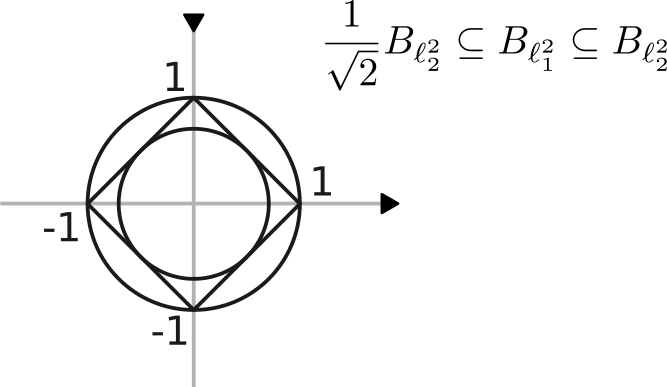
Remarks
-
If $X \sim Y$, then $X$ complete $\iff Y$ complete.
If $\lVert \cdot \rVert, \lVert \cdot \rVert'$ are equivalent norms on a vector space $X$, then $(X,\lVert \cdot \rVert)$ is complete iff $(X, \lVert \cdot \rVert')$ is complete.
(Isomorphisms preserve completeness, since bilipschitz bijection)
-
Given normed spaces $X,Y$, on $X \oplus Y$ the norm $\lVert (x,y) \rVert_1 = \lVert x \rVert + \lVert y \rVert$ is equivalent to $$\lVert (x,y) \rVert_p \coloneqq \left(\lVert x \rVert_p + \lVert y \rVert_p \right)^{\frac{1}{p}} \; (1 \leq p < \infty)$$ $$\text{\& to } \lVert (x,y) \rVert_\infty \coloneqq \max\{\lVert x \rVert, \lVert y \rVert\}$$
-
On $C[0,1]$, $\lVert \cdot \rVert_\infty$ is complete and $\lVert \cdot \rVert_1$ is incomplete. So $\lVert \cdot \rVert_\infty \nsim \lVert \cdot \rVert_1$. (There does exist an easy direct proof)
However $\lVert f \rVert_1 = \int_0^1 |f(t) dt \leq \lVert f \rVert_\infty$.
So $Id: (C[0,1], \lVert \cdot \rVert_\infty \to (C[0,1], \lVert \cdot \rVert_1)$ is a cts linear bijection, but its inverse is not cts.
-
On $c_{00} = \text{span}\{e_n \mid n \in \mathbb{N}\}, \lVert \cdot \rVert_1 \nsim \lVert \cdot \rVert_2$:
Take $x = (1, 1, \dots, 1, 0, \dots)$, then $\lVert x \rVert_1 = n, \lVert x \rVert_2 = \sqrt n$.
Note Let $X,Y$ be normed spaces. In $\mathcal{B}(X,Y)$, convergence implies pointwise convergence (easy to check), i.e. if $T_n \to T$ in $\mathcal{B}(X,Y)$ then $\forall x \in X, T_n x \to Tx$ in $Y$. The converse is false in general, e.g. take $T_n: \ell_1 \to \mathbb{R}, T_n x = x_n$, then $T_n \to 0$ pointwise but $\lVert T_n \rVert = 1 \;\forall n$ (as $T_n(e_n) = 1$).
Theorem
Let $X,Y$ be normed spaces. If $Y$ is complete then $\mathcal{B}(X,Y)$ is complete.
Proof
Slogan: Cauchy $\implies$ ptwise Cauchy $\implies$ ptwise conv, then show ptwise limit is actually a uniform limit.
Let $(T_n)$ be a Cauchy sequence in $\mathcal{B}(X,Y)$.
Fix $x \in X$. Then $\lVert T_n x - T_m x \rVert \leq \lVert T_n - T_m \rVert \lVert x \rVert \to 0$ as $m,n \to \infty$. So $(T_n x)$ is Cauchy in $Y$, and hence convergent.
Hence we may define $T: X \to Y$, $Tx \coloneqq \lim_{n \to \infty} T_n x$.
-
$T$ linear: $$\begin{aligned} T(\lambda x + \mu y) &= \lim_{n \to \infty} \left(T_n(\lambda x + \mu y)\right)\\ &= \lim_{n \to \infty} (\lambda T_n x + \mu T_n y)\\ &= \lambda \lim_{n \to \infty} T_n x + \mu \lim_{n \to \infty} T_n y\\ &= \lambda Tx + \mu Ty \;\checkmark \end{aligned}$$
-
$T$ bounded:
- $(T_n)$ is Cauchy and so bounded: $\exists M \geq 0$ s.t. $\forall n, \lVert T_n \rVert \leq M$.
- Fix $x \in X. \;\forall n, \lVert T_n x \rVert \leq \lVert T_n \rVert \lVert x \rVert \leq M \lVert x \rVert.$
- Let $n \to \infty \implies \lVert Tx \rVert \leq M \lVert x \rVert. \;\checkmark$
-
$T_n \to T$ in operator norm:
- Let $\varepsilon > 0$, then $\exists N \in \mathbb{N}$ s.t. $\forall m,n \geq N, \lVert T_n - T_m \rVert \leq \varepsilon$.
- Fix $x \in X$. Then $\lVert T_n x - T_m x \rVert \leq \varepsilon \lVert x \rVert \;\forall m,n \geq N.$
- Keep $x$ and $n$ fixed, and let $m \to \infty. \implies \lVert T_n x - Tx \rVert \leq \varepsilon \lVert x \rVert$.
- Hence $\lVert T_n - T \rVert \leq \varepsilon$ for all $n$ suff large.
Dual Spaces
Let $X$ be a normed space. A functional on $X$ is a map $X \to $ scalar field.
The dual space $X^*$ of $X$ is the space of all bounded linear functionals on $X$, i.e. $X^* = \mathcal{B}(X,\mathbb{R})$, with the operator norm (recall: for $f \in X^*, \lVert f \rVert = \sup \big\{|f(x)| : x \in X, \lVert x \rVert \leq 1\big\}$). Since the scalar field is complete, ? says that
Theorem
For any normed space $X$, $X^*$ is a Banach space.
Notation: For $x \in X, f \in X^*$, let $\langle x,f\rangle = f(x)$.
Why the inner product notation?
It's a bilinear map, but the two arguments live in different spaces. Later we will see the Riesz representation theorem, which says that any linear functional $f$ on a Hilbert space $H$ is "represented" by a vector $y \in H$, which more precisely means that $f$ is the map that "dots with $y$": $f : x \mapsto \langle x,y\rangle$. Thus under this notation, $\langle x,f \rangle = \langle x,y \rangle$, the latter of which is an actual inner product. In other words, "$f$ is the same as its Riesz representer $y$".
Note: $0 \in X^*$. Anything else?
Theorem (Hahn-Banach, non-examinable)
Let $X$ be a normed space, $Y \subseteq X$ a subspace, $g \in Y^*$. Then $\exists f \in X^*$ s.t. $\left.f\right|_Y = g $ and $\lVert f \rVert = \lVert g \rVert$. In other words, we can extend functionals on $Y$ to functionals on $X$.
Corollary (existence of norming functional, non-examinable)
Let $X$ be a normed space, $x_0 \in X \setminus \{0\}$. Then $\exists f \in X^*, \lVert f \rVert = 1,$ s.t. $f(x_0) = \lVert x_0 \rVert.$
Remarks (non-examinable)
-
For any $g \in B_{X^*}, |g(x_0)| \leq \lVert g \rVert \cdot \lVert x_0 \rVert \leq \lVert x_0 \rVert$. The above corollary $\implies \exists f \in B_{X^*}$ s.t. $f(x_0) = \lVert x_0 \rVert$.
So $\lVert x_0 \rVert = \max \big\{ |g(x_0)|: g \in B_{X^*} \big\}.$ $f$ is a "norming functional" at $x_0$.
-
Given $x \neq y \in X$, let $x_0 = x-y$, then the above corollary $\implies \exists f \in X^*$ s.y. $f(x) \neq f(y)$. Thus $X^*$ "separates the points" in $X$.
-
Proof of ?: $Y \coloneqq \text{span}\{x_0\}, g(\lambda x_0) \coloneqq \lambda \lVert x_0 \rVert$. Then $g \in S_{Y^*}, g(x_0) = \lVert x_0 \rVert.$ Apply Hahn-Banach.
Dual space of $\ell_p$
For $1 \leq p < \infty$, recall $\ell_p = \overline{\text{span}}\{e_n \mid n \in \mathbb{N}\} = \overline{c_{00}}.$
$\forall f \in \ell_p^*:$ for $x = (x_n) \in \ell_p, f(x) = f(\lim_{n \to \infty} \sum_{k=1}^n x_k e_k) = \sum_{k=1}^\infty x_k f(e_k)$ by linearity.
So, $f$ corresponds to the sequence $y = (f(e_n))$, and $f$ is the map that "dots with $y$".
Through this correspondence ($y \leftrightarrow$ map that dots with $y$), we aim to show that $\ell_p^* \cong \ell_q$, where $q$ is the conjugate index of $p \;\left(\frac{1}{p} + \frac{1}{q} = 1\right)$.
Theorem
Let $1 < p < \infty$ and let $\frac{1}{p} + \frac{1}{q} = 1$. Then $\ell_p^*$ is isometrically isomorphic to $\ell_q$.
Proof
Fix $y = (y_n) \in \ell_q$. Define $\varphi_y: \ell_p \to \mathbb{R}$ by $\varphi_y(x) \coloneqq \sum_{n=1}^\infty x_n y_n$ where $x = (x_n)$; this converges by Hölder, and $\varphi_y$ linear bounded: $\lVert \varphi_y \rVert \leq \lVert y \rVert_q$. So $\varphi_y \in \ell_p^*$.
Hence if we define $\varphi: \ell_q \to \ell_p^*, y \mapsto \varphi_y$, we have $\varphi$ linear bdd with $\lVert \varphi \rVert \leq 1.$
We'll show $\varphi$ is the required isometric isomorphism; remains to check surjective and isometric.
Isometric:
-
Need $\lVert \varphi_y \rVert = \lVert y \rVert_q$, i.e. that $\lVert \varphi_y \rVert \geq \lVert y \rVert_q$ (we already showed the other direction).
-
WLOG $y \neq 0$. Define $$x_n = \begin{cases} \frac{|y_n|^q}{y_n} & \text{if } y_n \neq 0 \\ 0 & \text{if } y_n = 0 \end{cases}$$
$x \in \ell_p \,? \; \underbrace{\sum |x_n|^p = \sum |y_n|^{(q-1)/p} = \sum |y_n|^q = \lVert y \rVert_q^q < \infty}_{\text{i.e. } \lVert x \rVert_p^p = \lVert y \rVert_q^q} \;\checkmark$
-
Now, $x \neq 0$ (as $y \neq 0 $) $\implies \frac{x}{\lVert x \rVert_p} \in B_{\ell_p}$, so $$\begin{aligned} \lVert \varphi_y \rVert &\geq \varphi_y\left(\frac{x}{\lVert x \rVert_p}\right)\\ &= \frac{1}{\lVert x \rVert_p} \sum x_n y_n = \frac{1}{\lVert x \rVert_p} \sum |y_n|^q = \frac{\lVert y \rVert_q^q}{\lVert y \rVert_q^{q/p}} = \lVert y \rVert_q \end{aligned}$$
Hence $\lVert \varphi_y \rVert = \lVert y \rVert_q$ as required.
recurring idea: bounding operator norms
To show operator norm is $\leq$ something, just bound it, and to show $\geq$ something, pick out a specific input.
Surjective:
-
Fix $f \in \ell_p^*$. Seek $y \in \ell_q$ s.t. $f = \varphi_y$.
-
As in the "correspondence" above, define $y_n = f(e_n) \;(n \in \mathbb{N}), y = (y_n).$
Is $y \in \ell_q \; ?$
-
Set $x_n = \begin{cases} \frac{|y_n|^q}{y_n} & \text{if } y_n \neq 0, n \leq N\\ 0 & \text{ else} \end{cases}$
-
Then $x = (x_n) \in \ell_p$ so $f(x) = \sum_{n=1}^N x_n f(e_n) = \sum_{n=1}^N x_n y_n = \sum_{n=1}^N |y_n|^q \leq \lVert f \rVert \cdot \lVert x \rVert_p.$
-
Also $\lVert x \rVert_p = \left(\sum_{n=1}^N |x_n|^p\right)^{1/p} = \left(\sum_{n=1}^N |y_n|^{(q-1)p}\right)^{1/p} = \left(\sum_{n=1}^N |y_n|^q\right)^{1/p}$
-
Hence $\sum_{n=1}^N |y_n|^q \leq \lVert f \rVert \left(\sum_{n=1}^N |y_n|^q\right)^{1/p}$. Divide both sides to get $\left(\sum_{n=1}^N |y_n|^q \right)^{1/q} \leq \lVert f \rVert$. Let $N \to \infty \implies y \in \ell_q \; \checkmark$
(WLOG we didn't divide by 0, because if $\sum_{n=1}^N |y_n|^q = 0$ then it's true anyway)
-
-
Now $f(e_n) = y_n = \varphi_y(e_n) \;\forall n \in \mathbb{N}$ $$\implies f(x) = \varphi_y(x) \;\forall x \in \text{span}\{e_n \mid n \in \mathbb{N}\} = c_{00} \quad \text{ by linearity}$$ $$\implies f(x) = \varphi_y(x) \;\forall x \in \overline{\text{span}}\{e_n \mid n \in \mathbb{N}\} = \ell_p \quad \text{ by continuity}$$
So $f = \varphi_y$ as required.
In this proof we define $x_n = |y_n|^q / y_n$ twice, but one of the times we truncate the terms, so that we avoid the issue of dividing by infinity.
Hence $\ell_p^* \cong \ell_q.$
Remarks
-
By analogous proofs, we also have $\ell_1^* \cong \ell_\infty, c_0^* \cong \ell_1$ (see example sheet 1).
The proof also shows that $\ell_1$ embeds into $\ell_\infty^*$ isometrically, but the proof of surjectivity breaks down since $\overline{\text{span}}\{e_n \mid n \in \mathbb{N}\} = c_0$ in $\ell_\infty$, but $c_0 \subsetneq \ell_\infty$.
-
From the proof, can show that ? holds for $\ell_p$.
-
We have shown $\ell_p, 1 \leq p \leq \infty$ are complete, as they are dual spaces. $c_0$ and $c$ are then complete because they're closed in $\ell_\infty$.
Bidual
$X$ normed space. $X^{**} = (X^*)^* = \mathcal{B}(X^*,\mathbb{R})$ is the bidual or second dual of $X$.
For $x \in X$, define $\hat{x}: X^* \to \mathbb{R}$ by $\underbrace{\hat{x}(f) = f(x)}_{\langle f, \hat{x}\rangle = \langle x,f \rangle}$ for $f \in X^*$.
This is linear and bdd: $|\hat{x}(f)| = |f(x)| \leq \lVert f \rVert \cdot \lVert x \rVert$ so $\hat{x} \in X^{**}, \lVert \hat{x} \rVert \leq \lVert x \rVert.$
So have $X \to X^{**}, x \mapsto \hat{x}$. This is linear: $\widehat{\lambda x + \mu y}(f) = f(\lambda x + \mu y) = \lambda f(x) + \mu f(y) = (\lambda \hat{x} + \mu \hat{y})(f).$
This map $x \mapsto \hat{x}$ is an isometric embedding $X \hookrightarrow X^{**}$ (non-examinable)
For $x \neq 0$, let $f \in X^*$ be a norming functional at $x$ (by ?), i.e. $\lVert f \rVert = 1, f(x) = \lVert x \rVert$. Then $\hat{x}(f) = f(x) = \lVert x \rVert$. Hence $\lVert \hat{x} \rVert = \lVert x \rVert$.
So the canonical map $X \to X^{**}, x \mapsto \hat{x}$ is an isometric isomorphism into $X^{**}$. If surjective, say $X$ is reflexive.
Dual operators
Definition
Let $X,Y$ be normed spaces and fix $T \in \mathcal{B}(X,Y)$. The dual operator $T^*$ of $T$ is the map $T^*: Y^* \to X^*$ defined by $T^*(g) = g \circ T$.
By ?, $T^*(g) = g \circ T \in X^*$ and $\lVert T^*(g) \rVert \leq \lVert g \rVert \cdot \lVert T \rVert$. So $T^*$ is well-defined. It is clearly linear, and bounded with $\lVert T^* \rVert \leq \lVert T \rVert$.
Remark: Recall that for $x \in X, f \in X^*, \langle x,f \rangle = f(x).$ Note that $\langle\cdot,\cdot\rangle : X \times X^* \to $ scalars is bilinear. For $x \in X, g \in Y^*, \langle x,T^*(g)\rangle = \langle T(x),g\rangle.$
$\lVert T^* \rVert = \lVert T \rVert$ (non-examinable)
$$\begin{aligned} \lVert T^* \rVert = \text{sup}_{g \in B_{Y^*}} \lVert T^* g \rVert &= \text{sup}_{g \in B_{Y^*}} \text{sup}_{x \in B_X} |\langle x,T^* g\rangle| \\ &= \text{sup}_{g \in B_X} \underbrace{\text{sup}_{x \in B_{Y^*}} |\langle Tx,g\rangle|}_{ (*) } \end{aligned}$$
But $(*) = \lVert Tx \rVert$ by ?, thus $\lVert T^* \rVert = \lVert T \rVert.$
Example
Let $1 < p,q < \infty, \frac{1}{p}+\frac{1}{q}=1$. Consider $R: \ell_p \to \ell_p, R(x_1,x_2,\dots) = (0,x_1,x_2,\dots)$ (right shift). What is $R^*:\ell_p^* \to \ell_p^*$?
Recall we have $\ell_p^* \cong \ell_q$ ($y \leftrightarrow \varphi_y$, the map that dots with $y$). We can compute what $R^*$ does to an arbitrary $\varphi_y \in \ell_p^*$:
$$\begin{aligned} (R^*\varphi_y)(x) &=(\varphi_y \circ R)(x) \\ &=\sum_{n=1}^\infty (Rx)_ny_n \\ &=\sum_{n=1}^\infty x_ny_{n+1}. \end{aligned}$$
Hence $R^*\varphi_y=\varphi_z$ where $z=(y_2,y_3,\dots)$.
So, thought of as $R^*:\ell_q \to \ell_q$, we have that $R^*$ is the left shift $L: \ell_q \to \ell_q,\; L(y_1,y_2,\dots)=(y_2,y_3,\dots)$.
Properties
-
$(Id_X)^* = Id_{X^*}$
-
$(\lambda S + \mu T)^* = \lambda S^* + \mu T^* \;(S,T \in \mathcal{B}(X,Y), \; \lambda,\mu \text{ scalars})$
Indeed, for $g \in Y^*, x \in X,$
$$\begin{aligned} \langle x,(\lambda S + \mu T)^* g\rangle = \langle (\lambda S + \mu T)x,g\rangle &= \langle\lambda Sx + \mu Tx,g\rangle\\ &= \lambda \langle Sx,g\rangle + \mu\langle Tx,g\rangle\\ &= \lambda \langle x,S^*g\rangle + \mu\langle x,T^*g\rangle\\ &= \langle x,(\lambda S^* + \mu T^*)g\rangle \end{aligned}$$
Since $x$ arbitrary, have $(\lambda S + \mu T)^* g = (\lambda S^* + \mu T^*)g$
Since $g$ arbitrary, have $(\lambda S + \mu T)^* = \lambda S^* + \mu T^*$, as required.
-
$(ST)^* = T^* S^* \;(T \in \mathcal{B}(X,Y), S \in \mathcal{B}(Y,Z))$
Indeed, $\langle x,(ST)^* g\rangle = \langle (ST)x,g\rangle = \langle S(Tx),g\rangle = \langle Tx,S^* g\rangle = \langle x,T^*(S^* g)\rangle = \langle x,(T^*S^*) g\rangle \;\checkmark$
Our "inner product" notation has allowed us to "pretend we are working with Hilbert spaces and the adjoint map" and use the same proofs (see the Hilbert Spaces section) TODO
-
Let $T \in \mathcal{B}(X,Y)$. We have $T^* \in \mathcal{B}(Y^*,X^*)$ and $T^{**} = (T^*)^* \in \mathcal{B}(X^{**},Y^{**})$.
The diagram commutes, i.e. $\widehat{Tx} = T^{**}\hat{x} \;\forall x \in X$.
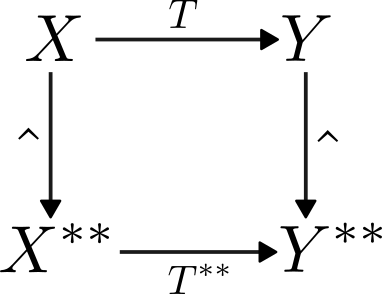
Indeed, for $x \in X$ and $g \in Y^*,\quad\langle g,T^{**}\hat{x}\rangle = \langle T^* g,\hat{x}\rangle = \langle x,T^*g\rangle = \langle Tx,g\rangle = \langle g,\widehat{Tx}\rangle\;\checkmark$
Note: $ \raisebox{.5pt}{\textcircled{\footnotesize{1}}} + \raisebox{.5pt}{\textcircled{\footnotesize{3}}}$ show: $X \sim Y \implies X^* \sim Y^*$
Sidenote: did I accidentally create an optical illusion? The axes seem all wonky...